JAMB preparation · in development
Know exactly where a student stands. Not how they feel about it.
Machine learning measures what a student actually knows, topic by topic. AI explains it to them and to their parents, and it cannot invent a single number. It works for any standardised exam — JAMB is the first.
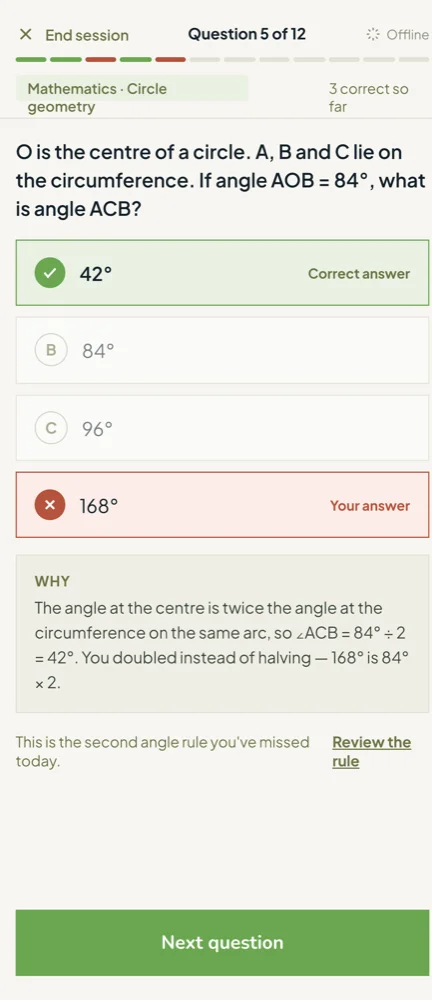
Almost all of them prepare the same way. Push forward, and hope.
A student can answer three thousand questions, feel like they worked hard, and walk into the hall with no idea what is waiting for them.
- No plan Students open a past-questions book at question one and keep going. Nothing tells them what to work on, in what order, or when to move on.
- No measurement They cannot see which topics are costing them marks. Effort goes in and lands nowhere in particular.
- No one watching Parents cannot make the time, and the syllabus has moved past what they remember. The person paying for the preparation is the one who can see the least.
Every prep app now claims an AI tutor. Most will invent your score on request.
Ask one how you are doing and it will tell you. Confidently. In a number it made up moments earlier, because there is no measurement underneath it. It is guessing, in a friendly voice.
For an exam that decides where a young person spends the next five years, a system that fakes certainty is worse than no system at all.
This is not another GPT wrapper.
- Rejected “Ada is at 72% mastery in quadratic equations and should improve by about 8 points next week.” Emits numbers, and predicts a future score — two rules broken at once.
- Permitted “Ada has moved from Developing to Building in Algebra. There is not enough data yet in Geometry.” States a real change and names the specific gap.
What a student sees
Real numbers. And an honest gap where the numbers are not there yet.
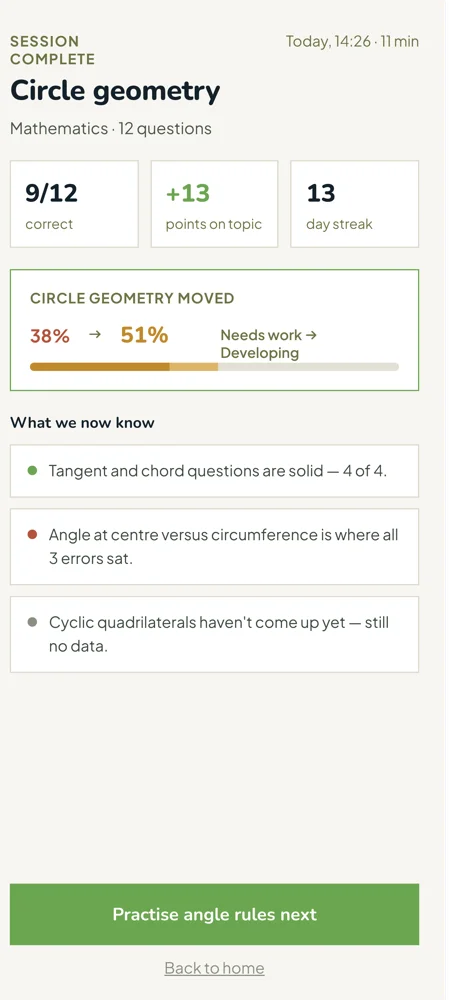
Every topic carries a figure: the percentage correct on the questions actually attempted, how that has moved over time, and how much evidence it rests on.
Where a student has not answered enough for the measurement to mean anything, we do not fill the space with a guess. The topic reads not enough data yet, and the next practice session goes and finds out.
The three subjects here are the ones ready first; others follow as their question banks are confirmed. Switch subject on the panel to see how the same measurement behaves with plenty of evidence, and with almost none.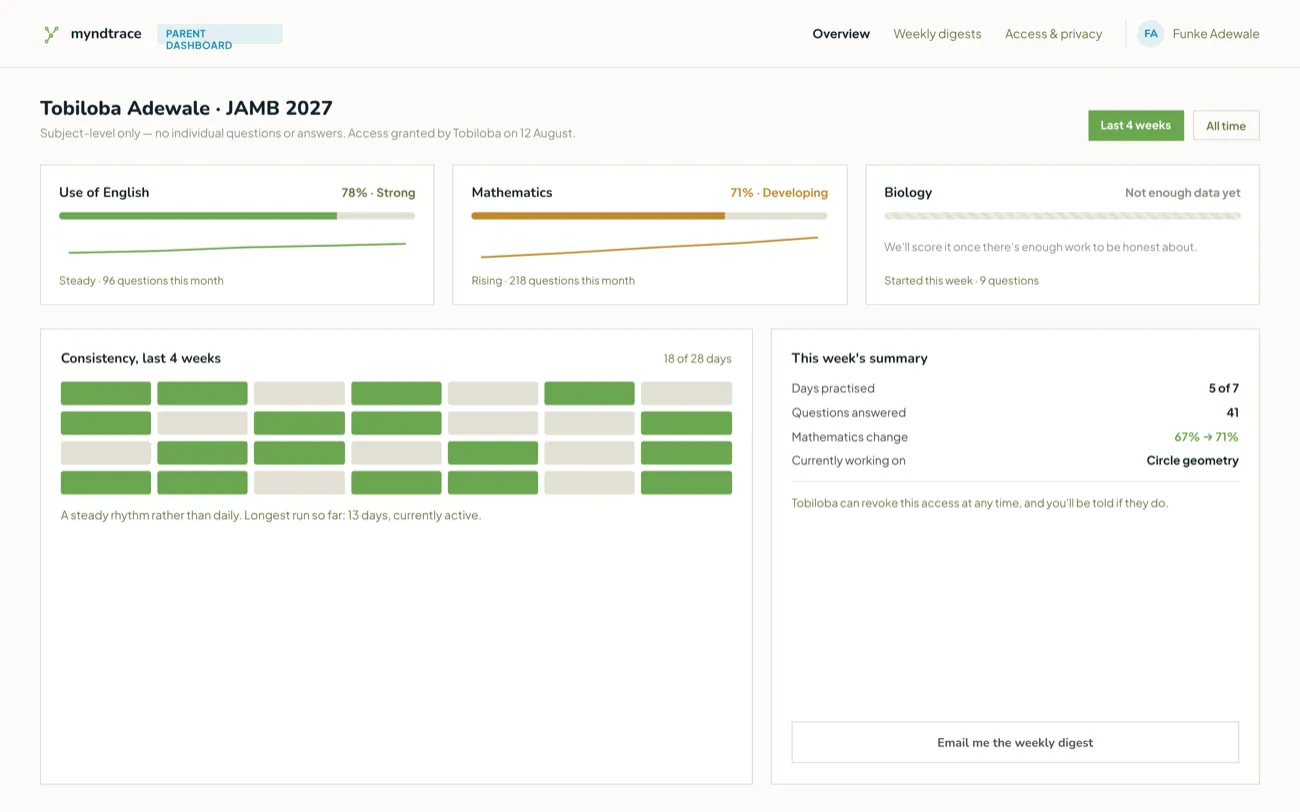
What a parent sees
A weekly read you can trust, in thirty seconds.
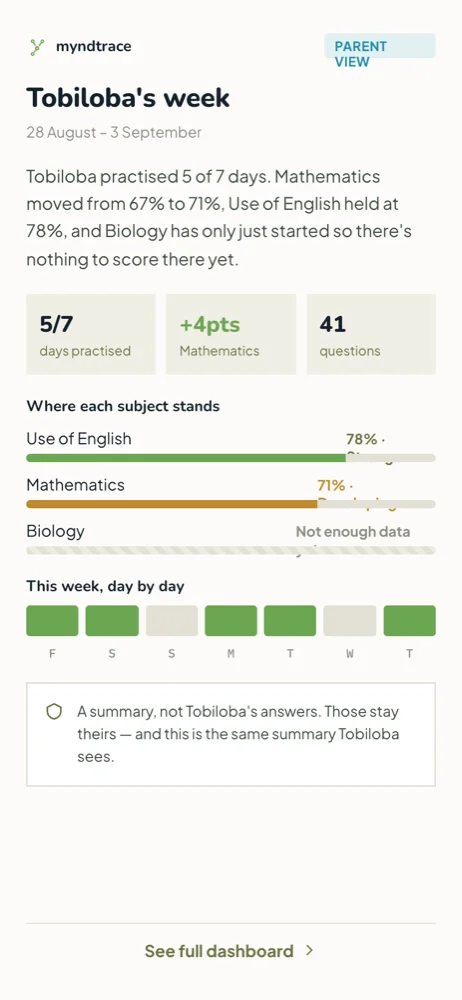
Parents get a short summary in plain language, and the figures that matter. Not analytics to interpret. Not a dashboard to learn.
This week — Tobiloba practised 5 of 7 days. Mathematics moved from 67% to 71%. Use of English steady at 78%. Biology: not enough data yet.
How is he doing in Maths?
He’s moved from Developing to Building in Mathematics this month. Indices and quadratics are solid; circle geometry is the current gap.
On WhatsApp
It reaches parents where they already are.
Every week, a short summary of how your child is doing arrives on WhatsApp. No app to open, no password to remember, no dashboard to learn.
And you can ask. Message the number and get an answer about how your child is progressing, drawn from the same measurements the student sees.
The answers come from the measurement layer, not from a chatbot improvising. What you are told is what the system actually knows.
- A weekly summary, delivered automatically
- Ask a question any time and get a straight answer
- The same figures the student sees, nothing hidden and nothing invented
- Linked with the student’s own approval, and revocable at any time
How it works
Three layers. The boundary between them is enforced in code.
Every answer is written once, permanently, tagged to a topic. For each topic we hold an estimate, an uncertainty, the evidence behind it, and how recently it was practised. The model works from the very first answer and states its own confidence, so a topic with three answers is never shown as though it had thirty.
A weighted function runs across every topic, balancing how much it is needed, how confident we are, how recently it was seen, and how much of the syllabus is covered. Where the evidence is thin it broadens instead of asserting a weakness it cannot support.
Only now does language get involved. The model receives a closed list of what it is allowed to mention, and a validator discards any sentence containing a number or naming anything not on that list. Every figure on the screen is drawn by the interface from measured state, never written by a model.
And it is built to improve. Events are ground truth and are never overwritten, so learner state is recomputed rather than stored. When the model gets better, it replays across every student’s entire history. Nothing has to be thrown away to improve it.
One engine. Every exam that matters.
The measurement layer does not care what is being learned. Each product inherits it, and every session on any product improves the measurement for all of them.
- JAMB prep Nigeria’s university entrance exam. English, Mathematics and Biology at launch. In development
- WAEC prep Largely the same candidate, sat months apart. The corpus changes; nothing underneath it does. Planned
- NECO prep The third leg of the Nigerian secondary examination path. Planned
- SAT prep The same engine aimed at students applying abroad. Planned
- IELTS prep The English test for studying, working or migrating abroad — reading, listening, speaking and writing. Planned
- Office prep Staff training for organisations that need evidence the training actually landed. Exploring
The three things this needs, in the same people.
Two further core members join the team after version one ships.
Be in the first cohort.
We are opening JAMB prep to a small first group of students and parents. Small deliberately: we would rather a hundred people trust what we tell them than a hundred thousand ignore it.
You’re on the list
We’ll be in touch when JAMB prep opens. Thank you.